Why Do You Need a Second-Hand Concrete Pump Truck?

A concrete pump truck is becoming the smart choice for many contractors in 2026 because of high new-machine prices, tight project schedules, and limited budgets. More and more contractors are turning their attention to second-hand concrete pump trucks. A well-maintained used machine can often meet your needs at half the price of a new one — or even less. Same work, lower cost, higher efficiency. However, opportunity often comes with risk. The repair costs and downtime caused by potential problem machines make many people hesitant about the uneven quality of the used equipment market. But don’t worry — iMachine, a used equipment platform with professional purchasing experience, provides a detailed guide to selecting a second-hand concrete pump truck, helping you find the ideal used machine.
Brand Selection for Second-Hand Concrete Pump Trucks: Match Strengths to Working Conditions
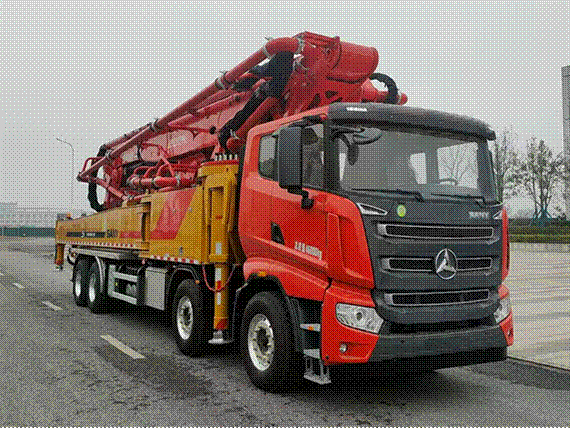
Machine primarily deals in second-hand concrete pump trucks from four major brands: SANY, Zoomlion, XCMG, and Putzmeister. Understanding each brand’s core advantages and then matching them to actual working conditions can greatly improve your selection accuracy when buying a second-hand concrete pump truck.
Leads the global concrete pump market in fleet size (approx. 40%, including Putzmeister). Most abundant parts supply, comprehensive global service network, convenient and controllable maintenance costs. Excellent secondary market liquidity and stable residual value (typically 5–10% higher than peer competitors of the same configuration after 3–4 years). Balanced overall performance and outstanding cost-effectiveness — suitable for most conventional construction scenarios and rental companies. Popular used models include the SYM series 37m, 48/49m, 52m, 56m, 62m, etc. (e.g., SYM5449THB 56m, SYM series 62m). Advantages: easy parts availability, fast resale, and low overall cost of ownership.
Zoomlion
Global market share approx. 23%. After acquiring Italy’s CIFA, it integrated European technology. Strong intelligent control and ergonomics, high operating comfort, and smooth boom movement (some 5-axle models reach placing heights of up to 67 meters). High equipment stability and relatively low failure rates — suitable for users who value driving experience and long-term reliability. Residual value is slightly lower than SANY, but parts costs are competitive. Popular used models include the ZLJ series 47X-5RZ, 49m, 52m, 56m, etc. High cost-performance; intelligence and operating comfort are standout features.

XCMG
Solid overall structure with excellent chassis passability and adaptability (outstanding length-to-weight ratio). Some models are more flexible in complex road conditions and space-constrained sites — suitable for projects with high requirements for vehicle mobility and site adaptability. Strong price competitiveness, but residual value and global parts network are slightly weaker than SANY. Suitable for budget-sensitive users or specific working conditions. Popular used models include the HB series such as HB37V, HB52, HB58V, HB62V, etc. Advantages: better chassis adaptability and more friendly entry-level pricing.

Putzmeister
German technical heritage (owned by SANY since 2012). High precision and stability in pumping systems and booms, outstanding durability, and excellent reputation in the high-end market and high-utilization fleets. Suitable for users with extremely high reliability requirements and relatively sufficient budgets. Used prices are usually higher (significant new-machine premium), but fewer failures and controllable maintenance costs in long-term use; strong residual value retention (residual value rates can reach 58–62% in some markets). Popular used models include M36, M46/47, M56, BSF series, etc. Advantages: precision, durability, and low long-term failure costs.

Second-Hand Concrete Pump Truck Price Comparison by Brand
When buying a second-hand concrete pump truck, price and residual value are the biggest concerns.
| Rank | Brand | Price Level | Notes |
| 1 | Putzmeister | Highest | Clear premium at same configuration; German heritage + reliability supports high prices |
| 2 | SANY | Mid-High | High liquidity, stable listing prices; slightly lower than Putzmeister |
| 3 | Zoomlion | Medium | Close to SANY, but usually slightly lower |
| 4 | XCMG | Relatively Lowest | Lowest entry threshold; often cheaper than SANY/Zoomlion |
- Best overall choice for most buyers: SANY — large fleet, easy parts, easy resale, lowest total cost of ownership for a second-hand concrete pump truck.
- Highest residual value: Putzmeister
- Best budget option: XCMG
Best Second-Hand Concrete Pump Truck by Working Conditions
| Working Condition | Recommended Brands | Reason |
| High-rise & intensive operations | SANY, Putzmeister | High cost-performance + proven reliability |
| Mid-to-high-rise & municipal projects | Zoomlion, SANY | Balanced performance, easy resale |
| Complex / space-constrained sites | XCMG | Better chassis passability and adaptability |
| Limited budget | SANY, Zoomlion | Competitive price, easy parts, low maintenance |
| Maximum reliability | Putzmeister or low-hour SANY | Lowest long-term risk |
| Plan to resell later | SANY, Zoomlion | Best liquidity and residual value |
Chassis Selection for a Second-Hand Concrete Pump Truck
The chassis is critical when evaluating any second-hand concrete pump truck. Main options:
1. Mercedes-Benz
- Core advantages: Low-speed high-torque, outstanding off-road and climbing ability; high reliability with low failure rates under intensive use; best residual value and highest market recognition; comfortable driving and advanced intelligence.
- Suitable for: Users with sufficient budget, complex road conditions, who value uptime and later resale.
2. Isuzu
- Core advantages: Proven long-term durability and high cost-performance; relatively convenient parts supply; controllable fuel consumption and overall cost of ownership; large used market volume.
- Suitable for: Mainstream users seeking a balance between performance and price — outstanding overall cost-performance.
3. SANY
- Core advantages: High matching degree with the superstructure and good integration; price significantly lower than most international chassis brands; rapid technology improvement in recent years, performance approaching mainstream international levels; lower maintenance costs.
- Suitable for: Users with limited budgets who prioritize usage and do not have extreme residual value requirements.
4. Volvo
- Core advantages: Extremely strong durability; high-torque + small-ratio rear axle design allows low-speed engine operation with less wear; common cases of high mileage without major overhauls; high comfort and safety.
- Suitable for: Users with frequent long-distance transfers who pursue ultra-long service life. Good residual value, but price and maintenance costs are usually higher than Isuzu.
5. Scania
- Core advantages: Powerful performance, excellent modular design, high maintenance convenience; top-tier fuel economy and reliability; outstanding driving experience.
- Suitable for: Users with high requirements for power and fuel economy who are willing to accept higher upfront costs. High market recognition, but fleet size is usually lower than Mercedes-Benz and Isuzu.
6. Hino
- Core advantages: Strong durability, high reliability and refinement; excellent fuel consumption; good cab comfort.
- Suitable for: Users who value daily operating economy and comfort. Good parts network in some markets, but overall fleet size and residual value are usually not as good as Isuzu.
7. HOWO
- Core advantages: Lowest price and lowest entry threshold; cheap repairs and easy parts availability; sufficient load capacity for conventional pump truck needs.
- Suitable for: Users with tight budgets, short-term projects, and acceptable road conditions. Weaker residual value; reliability under intensive use or complex road conditions lags behind mainstream international brands.
Quick Comparison Summary
| Brand | Reliability | Residual Value | Price | Power / Off-road | Parts & Repair Cost |
| Mercedes-Benz | Highest | Strongest | Highest | Strongest | High |
| Scania | Very High | Strong | High | Strong | Relatively High |
| Volvo | Very High | Strong | High | Strong | Relatively High |
| Isuzu | High | Strong | Medium | Good | Medium |
| Hino | High | Medium | Medium | Good | Medium |
| SANY (in-house) | Mid-High | Medium | Lower | Good | Low |
| HOWO | Medium | Weaker | Lowest | Average | Lowest |
Practical Buying Tips for Second-Hand Machines
- Highest residual value + lowest risk → Mercedes-Benz
- Balance of power and fuel economy → Scania or Volvo
- Most balanced cost-performance → Isuzu
- Limited budget but want good matching → SANY
- Ultimate low cost → HOWO (requires stricter inspection of frame and drivetrain)
In actual purchases, the chassis brand is only the foundation. Frame deformation, condition of drive axles/transmission, operating hours, and maintenance records often determine real risk and later costs more than the brand itself.
What Are Your Real Needs Before Buying a Second-Hand Concrete Pump Truck?
Many buyers start by looking at price and boom length, while overlooking the most basic question — whether this machine matches their construction scenario.
Before viewing machines, it is recommended to clarify the following points:
- Pumping height and distance: Mainly working on how many floors? Approximate horizontal distance?
- Work intensity: Approximate daily pumping volume? Short-term project or long-term high-frequency use?
- Site conditions: Is the job site space-constrained? Any requirements for chassis passability and turning radius?
- Budget and holding period: How many years do you plan to use it? Any intention to resell later?
Once needs are clear, screening models and brands becomes more efficient, and you are less likely to be misled by machines that “look cheap.”
5 Core Elements to Check on a Second-Hand Concrete Pump Truck
This is the most critical part of selecting a second-hand concrete pump truck
1. Operating Hours Check for Second-Hand Concrete Pump Truck
- Operating hours are an important reference for judging machine condition, but should not be the only number you look at.
- Generally recommended to prioritize machines with operating hours in the 3,000–6,000 hour range and complete maintenance records.
- Too few hours is not necessarily good (idle time may cause seal aging); too many hours require focused inspection of major component wear.
- Judge comprehensively with age of use: a 3-year-old machine with 4,500 hours is usually “healthier” than an 8-year-old machine with only 2,000 hours.

2. Boom and Pumping System Check for Second-Hand Concrete Pump Truck
The boom is the core working component of a pump truck and also the part most prone to problems.
- Check the boom for cracks, deformation, or welding repair marks.
- Inspect hydraulic cylinders for leakage and hoses for aging or bulging.
- Focus on the wear of S-pipe, spectacle plate, cutting ring and other wear parts — these directly determine later maintenance costs.
- If possible, always conduct an actual pumping test to observe whether boom movement is smooth and whether there is abnormal vibration or noise.

3. Engine and Chassis Inspection of Second-Hand Concrete Pump Truck
The power system and running gear determine the vehicle’s uptime.
- Start the engine and listen for smooth operation; observe exhaust color (normal should show no obvious black or blue smoke).
- Check transmission and drive axles for abnormal noise or oil leakage.
- Inspect tire wear for evenness and the frame for severe rust or deformation.
- Pay special attention to whether the chassis shows traces of major accident repairs.

4. Maintenance Records and Second-Hand of Genuine Parts
Complete maintenance records can significantly reduce purchase risk.
- Prioritize machines with formal maintenance records that use genuine or well-known brand parts.
- Ask about major overhaul history: whether the engine, hydraulic pump, main cylinders, etc. have been replaced, and the time and brand of replacement.
- Machines without records are not absolutely unbuyable, but require more careful on-site inspection and a correspondingly lower psychological price.
5. On-site Trial Run and Professional Inspection
No matter how beautiful the photos and specifications are, nothing beats seeing it with your own eyes.
- Require the seller to conduct no-load and loaded trial runs; observe pumping pressure, boom extension/retraction, outrigger operation, etc.
- Check whether the electrical system, remote control, and safety devices are functioning normally.
- If conditions permit, entrust a third party or an experienced operator to inspect together, focusing on potential issues in the hydraulic system and structural components.
Precautions in the Transaction Process
- Try to choose sellers who can provide real working videos and detailed inspection reports.
- Clearly specify in the contract the technical condition of the vehicle, whether there has been any major accident, transfer responsibilities, etc.
- Be wary of machines priced “far below market” — low prices often hide major repairs or structural issues.
- Communicate transfer, insurance, transportation and other costs in advance to avoid later disputes.
Looking for a Reliable Second-Hand Concrete Pump Truck? iMachine Is Your Best Choice
iMachine maintains over 100 machines in stock year-round, including used concrete pump trucks, rotary drilling rigs, truck cranes and more. With a 10,000 m² yard and a Dubai distribution company, we serve customers across the Middle East and Africa, exporting to 80+ countries with a 92% satisfaction rate.
If you are looking for a reliable second-hand concrete pump truck, iMachine welcomes you. Browse our latest stock and get expert support today.