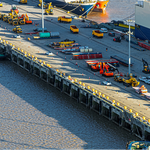
Recurring Morocco port‑wide cargo delay impacts nearly all import categories, including standard containers, general break‑bulk goods, alongside heavy‑duty construction units and so on.Construction machinery port delay can change the delivery plan long after a machine leaves China. For buyers in Morocco and Oman, the risk is not limited to the ocean voyage. A vessel may arrive on schedule, while customs checks, terminal handling, inland trucks, or berth availability keep a large machine inside or near the port.

Why Morocco and Oman Face Different Port Risks
Morocco: structural congestion centered on Casablanca
Morocco’s main problem is a structural mismatch between rising total import volumes and available port capacity. The congestion does not limit to construction machinery; containers, grain, animal feed and various break‑bulk cargo all suffer from terminal bottlenecks. Casablanca is carrying heavy cargo pressure while berth space, yard capacity, handling equipment, and truck circulation struggle to keep pace. Tanger Med remains an important gateway, but when its available capacity or service pattern cannot absorb all flows, more cargo pressure reaches Casablanca. MAP News citing National Ports Agency data, reported 17 million tonnes through Casablanca in the first half of 2026, with June volume up 32% year on year. Major shipping lines have imposed congestion surcharges for inbound container shipments. This is the core reason Morocco presents a persistent, rather than occasional, delay risk for all import goods.
Morocco: secondary disruption from weather, inspections, and vessel bunching
Other events can sharply worsen that structural pressure. Bad coastal weather, a channel or terminal incident, or a temporary work interruption can leave vessels waiting at anchorage while the terminal clears the backlog. For used construction machinery, the land-side stage is especially sensitive: customs may require physical examination and review of age or emissions information, while inland trucks may queue for hours before collecting released equipment. Le360 reported that Casablanca delays were concentrated on handling, inspections, and administrative formalities, and that truck productivity fell during the disruption. Several breakbulk vessels arriving together can magnify the same bottleneck.
Oman: route diversion is the main pressure point
Oman’s main problem is a sudden increase in cargo routed through Salalah and Sohar when Red Sea and Strait of Hormuz risks cause carriers to change schedules or discharge plans. More import cargo then competes for berth windows, yard space, and inland connections. Unlike Morocco’s long-running capacity mismatch, this pressure can rise quickly when shipping routes are redrawn. Salalah describes itself as a regional redistribution hub, while SOHAR highlights its Europe–Asia trade position; both roles make them important when regional cargo flows are rerouted.
Oman: secondary disruption from security events and heavy-lift limits
Security alerts or a port incident can temporarily pause operations and disturb an already tight schedule. Large used excavators, concrete pump trucks, and cranes add another bottleneck because they need heavy-lift equipment, special access, and coordinated handling. If heavy-lift slots are limited, oversized machinery may wait behind more standardized cargo. Cross-region delivery can also require additional customs and transit approvals after port release. The Port of Duqm provides another gateway with terminal and logistics-land services, but the suitable choice still depends on vessel availability, cargo dimensions, customs route, and inland destination.

Why Larger Machines Usually Wait Longer
Construction machinery port delay often increases with the cargo’s volume and weight. A compact excavator and concrete mixer truck may fit a regular handling workflow. A concrete pump truck needs space for its chassis and boom. A truck-mounted crane may require a heavy-lift slot, special lashing, wider access, or a coordinated gate movement. When one of these resources is unavailable, the machine cannot move at the same speed as standard cargo.
For this article, Imachine supplied an operational detention range rather than a universal industry average. The feedback indicates that equipment may remain detained for 20 days or, in extreme cases, more than one month. The same feedback follows a simple rule: the larger and heavier the equipment, the longer the potential waiting period. The chart below presents the supplied ranges as planning guidance only. It is not a guarantee for a specific port, vessel, or shipment.

What Is the Ship-Over-Delay Fee?
The supplied Imachine document identifies one specific port-delay charge: the ship-over-delay fee. When a vessel cannot berth as planned and must wait at anchorage, the operational feedback indicates a cost of about USD 6–7 per unit per day. This is not presented as a published universal tariff. It is a business-side estimate used for shipment planning and may vary by carrier, cargo, contract, and event.
The base ocean freight and the delay-related fee should therefore be discussed separately. A buyer should ask which charges are included in the quotation, when the delay fee can be triggered, which party receives the carrier invoice, and how a change of port or vessel schedule would affect the landed-cost calculation. Clear written terms are more useful than a low headline freight rate that leaves delay responsibility unclear.
How to Handles Port-Delay Risk
Select a suitable destination port
Imachine reviews the destination before confirming the shipping plan. For Morocco, the team can assess whether Tanger Med is a better fit than Casablanca for the cargo and delivery route. For Oman, the review can include Salalah, Sohar, and Duqm. The decision depends on the machine’s dimensions, the available service, customs requirements, inland destination, and the buyer’s delivery schedule.
Use Ro-Ro when the machine and route are suitable
Ro-Ro shipping can reduce some handling steps because self-propelled equipment is driven onto and off the vessel. The vessel and roll-trailer choice depends on the machinery’s size, weight and type, its machinery-shipping information also lists equipment such as cranes and excavators among the cargo handled through specialized Ro-Ro operations. Ro-Ro is not suitable for every unit, so the machine must be assessed for mobility, dimensions, cleanliness, securing, and destination-port compatibility.

Prepare documents before the vessel departs
Age information, machine specifications, serial numbers, inspection records, commercial documents, and loading details should be checked before departure. Complete paperwork cannot remove a port-wide queue, but it can reduce avoidable questions during customs review. Imachine can coordinate the document checklist with the selected machine and destination requirements.
Arrange inland transport before arrival
Port release is not the final delivery step. The buyer needs a suitable truck, route, permits where applicable, and a receiving plan. Imachine’s shipment planning approach is to prepare inland transport before the vessel arrives so that the machine can leave the port after release instead of waiting for an unconfirmed truck slot. Buyers can review the Imachine quality-control process alongside the shipment documents to keep product and logistics evidence aligned.
Reserve handling capacity for oversized units
Large cranes and pump trucks may need heavy-lift equipment, a specific gate window, special access, and additional coordination. The request should include exact length, width, height, gross weight, working condition, and whether attachments will be shipped with the machine. These details allow the logistics team to compare loading methods before a booking is finalized.
How Buyers Can Plan Around Construction Machinery Port Delay
Construction machinery port delay is a planning risk, not only a vessel schedule problem. Morocco’s 2026 cargo data and land-side reports show how high activity can affect truck and handling operations. Oman requires a more deliberate choice between gateways and transport connections. For Imachine shipments, machine size, weight, port selection, Ro-Ro suitability, documents, inland transport, and delay-charge terms should be reviewed together.
Before placing an order, the buyer should ask for a shipment plan that separates four time periods: preparation in China, ocean transit, possible port detention, and inland delivery after release. The plan should identify the destination port, shipping method, document deadline, expected handling requirements, and the person responsible for updates.
The buyer should also request a written explanation of the ship-over-delay feedback, including whether it applies per unit, when it begins, and how it would be allocated if the delay comes from a vessel or terminal event. A simple risk table is useful: machine dimensions, gross weight, selected port, shipping mode, expected transit, detention assumption, and inland-truck arrangement.
FAQ
Imachine operational feedback indicates that construction machinery may remain detained for 20 days or, in extreme cases more than one month. The larger and heavier the unit, the longer the potential wait.
It is a delay-related charge identified in Imachine shipment feedback when a vessel cannot berth as planned and waits at anchorage. The reported planning figure is about USD 6–7 per unit per day, not a universal published tariff.
Ro-Ro can reduce some crane-handling steps for suitable self-propelled machinery, but the machine, route, vessel, and destination terminal must all be compatible.
Confirm the machine’s exact dimensions and weight, destination port, shipping method, document list, possible delay-charge terms, inland transport, and the update process before departure.