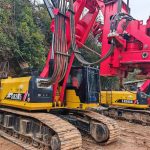
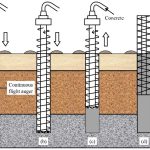
Understanding the key components of a rotary drilling rig is crucial for anyone involved in foundation piling and deep drilling operations. These powerful and complex machines are designed to bore into the earth efficiently, with each component playing a vital role in the overall drilling process. The following covers major components including the power head, mast and drill string, outlining their roles for operators and buyers of used rotary drilling rigs.

1. The Mast
The mast is the primary structural element of a rotary drilling rig. Constructed from high-strength steel, it provides a stable framework to support the weight of the drill string and drill bit during operations. At the top of the mast is the crown block, which contains a set of sheaves (pulleys) that guide the drilling line and help support the hoisting system.
2. Drill string
The drill string is a crucial component responsible for transmitting torque and thrust from the rotary table to the drill bit. It consists of drill pipes, drill collars, and the drill bit itself, enabling deep penetration into the ground.
3. The Swivel
Located at the top of the drill string, the swivel allows for continuous rotation while drilling and provides a pathway for drilling fluid (mud) to enter the drill string. This component ensures smooth drilling operations and fluid circulation.
4. The Rotary Table – Components of a Rotary Drilling Rig
The rotary table is a powerful turntable that rotates the drill string and drill bit. It is powered by either an electric motor or a diesel engine and is essential for transmitting rotational energy to the drilling assembly.
5. Mud Pumps
Mud pumps are critical for circulating drilling fluid through the drill string and out of the bit. They generate the pressure needed to carry cuttings to the surface and help maintain borehole stability.
6. Power Source (Engine) – Components of a Rotary Drilling Rig
The engine or power source drives all major components of the rotary drilling rig, including the rotary table, mud pumps, and hoisting system. Power can be supplied by diesel, electricity, or natural gas, depending on the rig’s configuration.
FAQ
The main components include power head, mast, drill string, hydraulic system, winch, chassis and control system.
A drill string is an assembly of drill rods and drill tools. It transfers torque and down pressure from the power head to the drill bit.
Focus on the power head, drill string, hydraulic pumps, chassis wear and control system.
The power head generates torque to rotate the drill string and drill bit, it is the core power component for drilling.
Conclusion
Each component of a rotary drilling rig works in harmony to achieve efficient and precise drilling, especially in foundation piling applications. Proper maintenance and understanding of these components are essential for optimizing performance and ensuring safety on the job site.Welcome to contact Imachine to know more information of drilling rig.