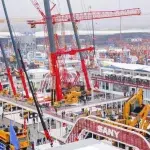
In megaprojects, wind turbine installations, petrochemical plant expansions, and high-rise construction, crawler cranes are the undisputed titans of heavy lifting. Known for their immense load capacities, excellent on-track mobility, and stability on rugged terrains, these machines are engineered to tackle the world’s most demanding rigging challenges.
To achieve maximum lifting height and a versatile working radius while clearing high obstacles, crawler cranes are frequently configured with a luffing tower jib. Understanding the precise anatomical structure of this setup is crucial for field engineers, safety officers, and heavy equipment buyers.
Based on professional structural engineering nomenclature, this article breaks down the core components and functional mechanics of a crawler crane in a luffing tower jib configuration.
1. The Stability & Counterweight System: Neutralizing the Overturning Moment
Every safe lift begins with a solid foundation. Because heavy lifting generates massive forward overturning moments, the crane relies on strategic weight distribution to maintain its center of gravity.
- Carbody Counterweight
- Location: Mounted directly onto the crawler chassis (lower frame) between the tracks.
- Function: It lowers the overall center of mass of the machine and directly stabilizes the lower undercarriage. Working in tandem with the upper slewing platform counterweights, it ensures the crane remains firmly grounded during 360-degree rotation.
- Superlift Counterweight
- Location: Positioned at the rear of the crane, suspended on a specialized tray or supported by a wheeled counterweight wagon linked via the superlift mast.
- Function: When executing ultra-heavy lifts or operating at an extended radius, standard counterweights fall short. The superlift counterweight acts as a physical leverage extension. By increasing the counter-lever arm distance, it dramatically upgrades the crane’s rated load chart capacity—often multiplying it by several factors.
2. Main Boom & Superlift Mast System: The Structural Axis of Force
The boom structure is designed to handle immense compression loads, while the mast system acts as the mechanical tension distributor.
- Main Boom
- Function: Constructed from high-tensile steel tubes in a lattice framework, the main boom offers an optimized strength-to-weight ratio with high resistance to bending and torsional forces. It acts as the primary compression member, transferring the weight of the jib, hook, and payload down to the slewing platform and chassis.
- Superlift Mast (Derrick Mast)
- Function: Mounted behind the main boom, it forms a large geometric “V” shape with the boom. The superlift mast does not directly carry the vertical weight of the payload; instead, it acts as a high-clearance strut for the tension rigging. By routing tension lines through the mast head, the superlift counterweight pulls back against the main boom, eliminating boom deflection and structural bending during heavy lifts.
- Main Boom Pendant
- Function: High-strength steel guy lines or rigid pendant bars that connect the main boom head back to the mast or gantry frame. They hold the main boom at its fixed operational angle and transmit structural tension safely to the rear counterweight assembly.
3. Luffing Tower Jib System: High-Altitude Articulation
The term “Tower Jib” is derived from the operational stance where the main boom stands almost vertically (acting like a crane tower), while the jib extends forward and alters its angle (luffing) to navigate complex airspace.
- Tower Jib
- Function: A lattice boom extension pin-connected to the main boom head. It allows the operator to reach over low buildings, process piping, or structural walls, providing an exceptional vertical reach and horizontal coverage radius.
- Tower Jib Rear Mast & Tower Jib Front Mast (Jib Struts)
- Function: These two structural masts form an articulated “A-frame” at the pivot point between the main boom and the jib. The Rear Mast remains relatively fixed to anchor the rear tension lines, while the Front Mast moves in alignment with the jib’s movement. Together, they provide the necessary leverage, mechanical advantage, and rigid support required to alter the jib’s angle under load.
- Tower Jib Hoisting Winch Wire Rope (Jib Luffing Rope)
- Function: A multi-reeved wire rope system spooled through the luffing winch and routed over the reeving sheaves of the front and rear masts. By spooling the rope in or out, the winch alters the distance between the two masts, directly controlling the luffing angle (working radius) of the tower jib.
- Tower Jib Pendants (Front & Rear)
- Function: * Front Pendants connect the front mast to the jib tip, suspending and supporting the jib structure.
- Rear Pendants anchor the rear mast back down to the crane’s lower tension-equalizing system. They serve as the high-tensile structural “tendons” of the high-altitude lift system.
- Function: * Front Pendants connect the front mast to the jib tip, suspending and supporting the jib structure.
4. Load Handling Execution: The Point of Target Delivery
- Hook Block
- Function: The terminal lifting assembly integrated with heavy-duty sheaves, a swivel hook, and safety latches. It is suspended from the jib tip by the main hoist wire rope. Utilizing the mechanical advantage of multi-part reeving, it converts the high-speed rotational torque of the hydraulic hoist winch into massive vertical lifting force to precisely position components.
Technical Reference: Quick Component-to-Function Matrix
| Component Name | Structural Classification | Primary Industrial Function |
| Carbody Counterweight | Ballast System | Lowers the machine’s center of gravity; stabilizes the crawler undercarriage. |
| Superlift Counterweight | Leverage Expansion | Extends the counter-lever arm; drastically boosts long-radius lifting capacities. |
| Main Boom | Lattice Compression Member | The structural spine; bears and transfers primary vertical compression forces. |
| Superlift Mast | Tension Support Strut | Elevates the tension lines; offsets boom bending moments under extreme load. |
| Tower Jib | Articulated Extension | Clears structural obstacles; extends horizontal reach and vertical hook height. |
| Front / Rear Masts | A-Frame Strut Assembly | Establishes geometric leverage points for smooth, controlled jib luffing. |
| Hoisting Winch Wire Rope | Power Transmission | Adjusts the spacing between masts to control the jib’s operational angle. |
| Hook Block | Load Handling Device | Multiplies winch line pull into heavy vertical lift capacity via load sheaves. |
Frequently Asked Questions (FAQ)
A fixed jib is locked at a pre-determined angle relative to the main boom, meaning any change in working radius requires moving the entire crane or booming up/down the main boom. A luffing tower jib can independently adjust its angle while the main boom remains static. This allows the operator to dynamically change the working radius and lift payloads up and over high structural barriers (like refinery walls or building facades) where space at the base is highly restricted.
Without a Superlift system, heavy payloads cause significant downward and forward bending forces (bending moments) on the lattice main boom, risking structural buckling. The Superlift mast acts as an overhead anchor point. The tension lines running over the mast pull backward on the boom head using the weight of the superlift counterweight. This converts the harmful bending forces into manageable, pure axial compression forces down the length of the boom, allowing the crane to safely lift much heavier loads.
Due to the extreme heights and the large surface area of the dual lattice structures (main boom + tower jib), wind speed monitoring at the jib tip is the most critical safety factor, as high-altitude winds are much stronger than ground winds. Additionally, operators must strictly monitor ground bearing pressure (ensuring the crawler tracks do not sink under shifting centers of gravity) and utilize advanced Rated Capacity Limiters (RCL) to prevent side-loading, which can cause catastrophic structural failure of the lattice frames.