On 1 October 2026, Kenya set aside KSh 5 billion (about US$38.5 million) to push its standard gauge railway from Voi to the Tanzanian border at Taveta. Two weeks later, on 15 October, President William Ruto launched a second package in the North Rift: 100 km of county roads and 3,000 affordable homes across Baringo and Elgeyo-Marakwet.
Together, the Kenya SGR extension and the North Rift package put more than KSh 24 billion (about US$186 million) into motion: KSh 5 billion for rail, KSh 6 billion for roads, KSh 13 billion for housing. For contractors bidding into these packages, the demand profile is earthwork-heavy on the rail formation and the roads, and concrete-heavy on the housing. That means 20–30 tonne excavators, graders and rollers first; 6–8 m³ mixer trucks, 37–47 m boom pumps and batching plants next; rotary drilling rigs only where rail bridges and multi-storey blocks need bored piles. Following sets out what was actually announced, which machines each package absorbs, and how to buy used units that survive Kenyan payment cycles.
What the Kenya SGR extension and road packages include
The Kenya SGR extension is a 130 km link from Voi through Mwatate, Bura and Mwakitau to Taveta, with four new stations and a connection into northern Tanzania. The road and housing package covers two counties in the North Rift, with the housing money concentrated in Elgeyo-Marakwet.
| Package | Announced | Value | Scope |
|---|---|---|---|
| Voi–Taveta SGR extension | 1 October 2026 | KSh 5 bn (~US$38.5 m) | 130 km, four stations (Mwatate, Bura, Mwakitau, Taveta), cross-border link to Tanzania |
| Baringo county roads | 15 October 2026 | KSh 4.2 bn (~US$32 m) | 70 km: Timboroa–Seguton–Arama–Moringwo and Poror–Magrib–Sirwa–Lawina–Ochii |
| Elgeyo-Marakwet county roads | 15 October 2026 | KSh 1.8 bn (~US$14 m) | 30 km linking Chepkorio township, Kaplimo and Kipsaina |
| Affordable housing, Elgeyo-Marakwet | 15 October 2026 | KSh 13 bn (~US$100 m) | 3,000 homes, hostels for 2,500 students, nine modern markets; Iten phase two is 678 units |
| Voi–Taveta metre-gauge revival (context) | Launched April 2026 | KSh 5.5 bn | 130 km rehabilitation, Voi dry port, stations at Voi, Mwatate, Bura, Maktau, Taveta |
Which machines each project actually needs
Rail formation is a bulk earthworks job with a narrow bridge component. County roads are a compaction and haulage job. Housing is a concrete placement job. Mixing the three into a single shopping list is how contractors end up need sevaral kinds machines.
Rail formation, bridges and stations
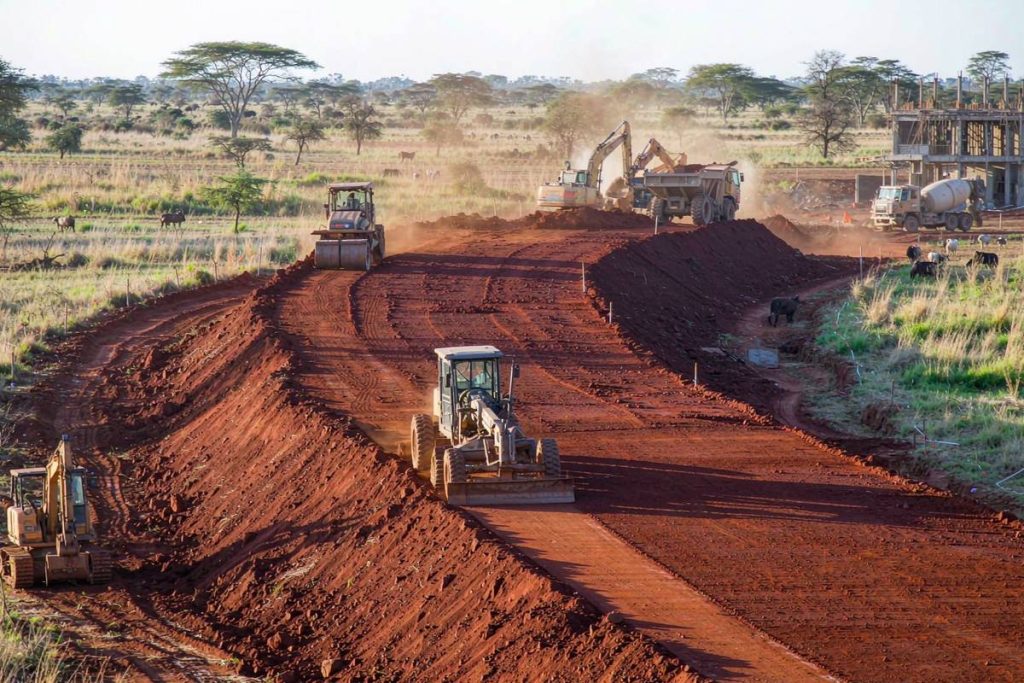
130 km of greenfield alignment means cut and fill at volume, split across several work fronts. Expect 20–30 tonne crawler excavators, articulated dump trucks, motor graders and single-drum vibratory rollers to carry most of the hours, with water tankers on dust control. Bridge piers and station structures add bored piling and lifting: a rotary drilling rig in the 220 class for pile groups, and crawler or rough-terrain cranes for precast spans and station steel.
100 km of county roads
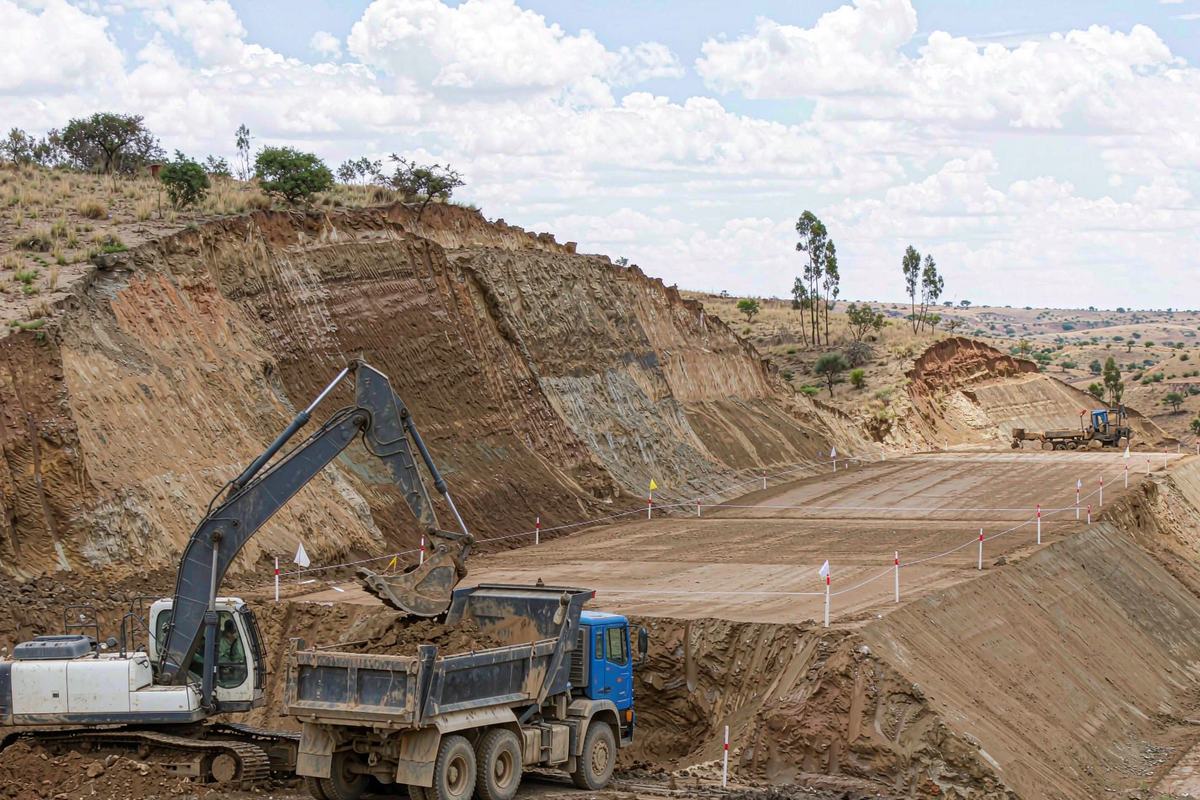
For rural links, the equipment list is narrower than a highway job. Wheel loaders with 3–5 m³ buckets handle aggregate and subgrade haulage, graders shape the formation, and 10–14 tonne single-drum rollers do the compaction. Asphalt plant only enters if a section is specified with bituminous surfacing; confirm the pavement design in the tender before pricing a paver and chip spreader.
3,000 homes, 2,500 beds and nine markets
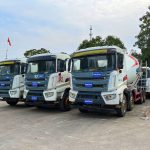
This is where concrete equipment earns its keep. Concrete Mixer trucks cycle between batching plant and pour, boom pumps place slabs and columns on the taller blocks, and wheel loaders feed the plant. For 678 units in a single phase, the constraint is rarely the pump — it is cycle time between the plant and the furthest block, which is a truck-count problem.
Where rotary driiling rigs actually fit
Piling is a bridge, stadium and mid-rise item, not a low-rise housing item. Affordable housing of two to four storeys on competent ground usually runs on strip or pad foundations. Budget a rotary drilling rig for rail bridge piers, stadium structures and any block specified with bored piles and do not buy one on the assumption that 3,000 homes will absorb it.For a country-specific selection, see our rotary drilling rigs for Nigeria page — the same classes apply to East African rail and bridge work.
| Work package | Ground or structure | Typical machines | Class to budget |
|---|---|---|---|
| Kenya SGR extension formation, 130 km | Cut and fill, multiple fronts | Crawler excavator, ADT, grader, roller | 20–30 t excavator; 10–14 t roller |
| SGR bridges and stations | Bored piles, precast spans | Rotary drilling rig, crawler crane | 220-class rig; 50–100 t crane |
| County roads, 100 km | Subgrade, gravel base | Wheel loader, grader, roller, water tanker | 3–5 m³ loader; 10–14 t roller |
| Housing, 3,000 units | Foundations, slabs, columns | Mixer truck, boom pump, batching plant | 6–8 m³ mixer; 37–47 m boom |
| Stadiums and markets | Steel and precast erection | Truck crane, mobile crane | 25–50 t crane |
The fine print contractors should read before bid
Three things decide whether these announcements become machine orders: procurement timing, payment behaviour and where the packages physically sit. Read them before you price a mobilisation.
Announcement is not award
The 15 October events were launches and foundation-stone ceremonies, not tender awards. County packages of this size usually go through county tender committees or KeNHA and KURA channels, and the award schedule has not been published. Contractors who buy machines on the strength of a launch date, rather than an award letter, carry the idle cost themselves.
Payment timing drives the equipment decision
On the same 15 October tour, Ruto defended the Road Maintenance Levy Fund on the grounds that its revenue had been used to clear pending bills owed to road contractors. A contractor carrying a KSh 40 million used fleet through a nine-month payment gap is in a very different position from one carrying a KSh 110 million new fleet through the same gap.
The pipeline is regional, not national
The Kenya SGR extension only pays back if it connects. Uganda is building a 272 km electrified SGR from Kampala to the Kenyan border at an estimated €2.7 billion, and Tanzania is extending its own network toward the Central Corridor. A machine bought for Kenyan rail formation has a second life across a border, which changes the resale calculation on a used construction machinery.
The macro backdrop supports the same call. The World Bank’s October 2026 Africa update raised Sub-Saharan Africa’s 2026 growth forecast to 4.3%, a 0.3 percentage point upgrade from April, with nearly three-quarters of countries in the region upgraded. Kenya’s transport build-out is one of the reasons that number moved.
Why used equipment wins these particular contracts
Large project fleets rarely buy everything new. Owners usually run three tracks in parallel: new units for core machines that will run thousands of hours a year, rental for peak demand, and used units for mid-specialist roles that finish their useful life when the project closes. On a 100 km road package plus a housing phase, most of the fleet sits in the third track.
Three forces push contractors toward used. A used unit typically costs 30–70% less than a new machine of the same class, depending on age and hours, which frees working capital for fuel, operators and the payment gap described above. Chinese yards hold ready stock, so a machine can load in days rather than waiting six to twelve months on a factory queue. And a project needs ten machine types, not ten machines — not every type justifies a new purchase that sits idle once the handover certificate is signed.
What to inspect before you wire the deposit
Used equipment in East Africa fails for predictable reasons. Six checks cover most of the risk on the classes listed above.
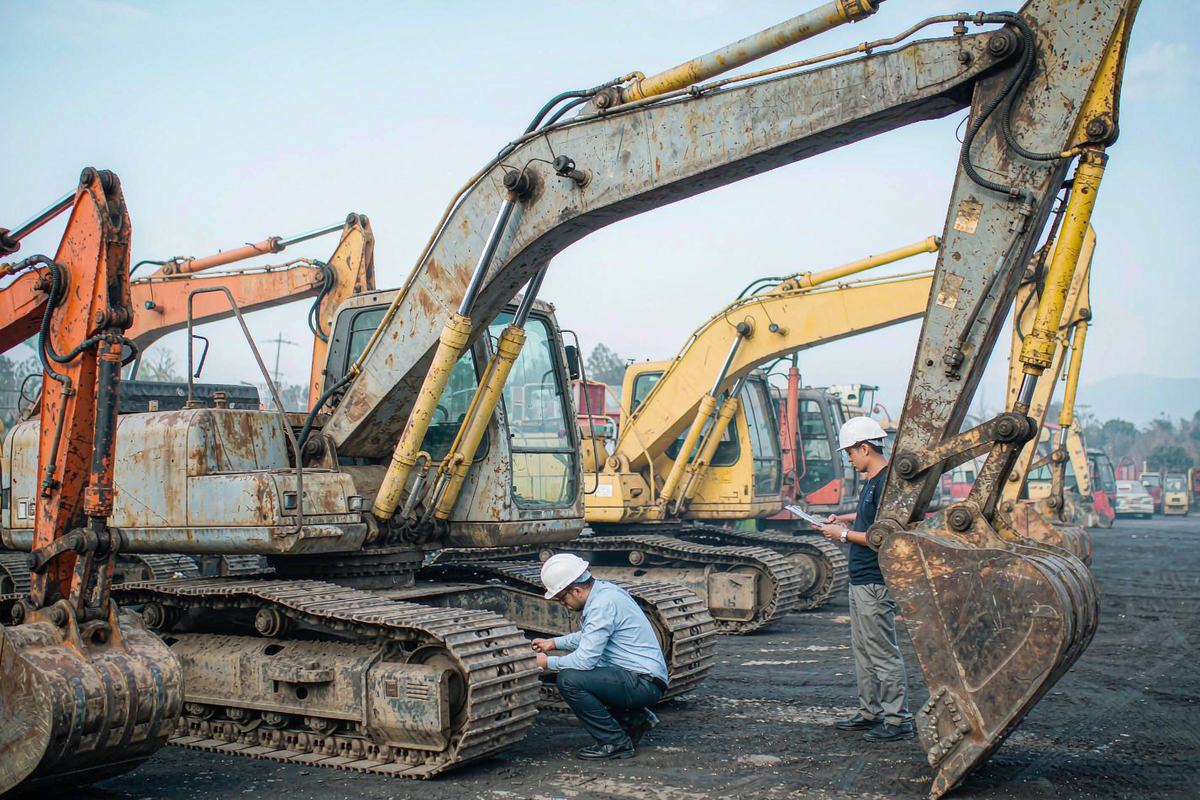
- Hour meter against service records. Below 8,000 hours with a documented history is the practical benchmark for mixers, loaders and 20–30 t excavators entering road work.
- Hydraulics before paint. Cylinder seepage, hose age and pump noise matter more than a fresh coat; a resprayed machine with original hoses is a warning, not a selling point.
- Drum and blade wear. On mixers, check drum shell thickness and blade clearance; on loaders, measure bucket edge and pin wear rather than judging by appearance.
- Boom and structure on pumps. Inspect boom sections for cracks and previous weld repairs, and confirm the outrigger cylinders hold under load.
- Parts channel in-country. Confirm a Nairobi or Mombasa parts route for the brand before purchase; a two-week wait for a hydraulic hose stops a pour and a road programme.
- Import paperwork. Verify the export certificate, inspection report and pre-shipment documentation with your clearing agent before the machine sails, not after it lands.
Questions Kenyan contractors actually ask
About KSh 5 billion, roughly US$38.5 million, announced on 1 October 2026 for the 130 km link from Voi to Taveta. A separate KSh 5.5 billion covers the parallel metre-gauge rehabilitation launched in April 2026.
Yes, on the housing side. The Sh13 billion Elgeyo-Marakwet package alone covers 3,000 homes, 2,500 student beds and nine markets, all of which need slab and foundation concrete. Mixer count, not pump capacity, is usually the limiting factor on dispersed sites.
Usually not. Two to four storey housing on competent ground runs on strip or pad foundations. Rotary rigs are justified on rail bridge piers, stadium structures and mid-rise blocks specified with bored piles.
Not published. The 15 October events were launches and foundation-stone ceremonies; award schedules for the county road packages have not been announced. Watch county tender portals, KeNHA and KURA rather than launch dates.
Yes. Used machines are standard on county road and housing packages, provided the unit meets the technical specification in the tender and import documentation is complete. What fails inspection is condition and paperwork, not the fact of being second-hand.
It connects Kenya’s SGR to Tanzania’s network and, through Uganda’s 272 km Kampala–Malaba line, to a continuous corridor. Machines bought for Kenyan rail formation can be redeployed across borders, which improves the resale case for used units.
Source your machines against the award calendar
The Kenya SGR extension is funded and the North Rift road and housing packages are physically under way. Equipment decisions follow the award letters, and the contractors who lock stock two to three months before mobilisation avoid the scramble. Tell Imachine your project — machine type, tonnage, quantity and required delivery — and the team returns a shortlist of matching stock within one working day.Browse the used construction machinery that fit this pipeline.
Reference
- The Standard, “Ruto unveils plan to extend SGR to Tanzania”, 2026
- The Star, “Ruto launches billions in projects across Baringo, Elgeyo-Marakwet”, 15 October 2026
- Kenya News Agency, “Mega road and railway projects position Kenya’s Coast as investment hub”, 2026
- Business Edge, “Kenya plans $38.5m SGR extension to Tanzania”, 2026
- World Bank, Africa’s Pulse, October 2026 edition